Twitter – AdTech or Fad-Tech?
With the recent news of Twitter’s disappointing Q1 2015 results and CEO Dick Costolo announcing his resignation, is Twitter an effective platform within adtech (the use of technology in relation to advertising) or is it just fad-tech that is nearing the end of its run?
Resignation
Costolo will be resigning from the position on 1 July 2015 and will be replaced on an interim basis by Twitter co-founder Jack Dorsey. Costolo has been on the board since 2010 and led the company through its Initial Public Offering (IPO) in November 2013 when it had a market cap of $24.5bn. Since then, Twitter’s valuation has decreased by 41% from a high of $40bn in December 2013 to its current market cap of $23.48bn. It is this stagnation that has led to Costolo’s resignation.
The Financial Numbers
From 2013 to 2014, Twitter has increased its annual revenue by 111% which has corresponded to a 10.46% increase in its net profit. However, this positive change still resulted in a net loss of $577m. Note that the results for the year ending December 31 2013 should not be overstated as 2013 was the year in which Twitter went public.
| All values in $000,000’s | |||
| Dec 31 2014 | Dec 31 2013 (Year of IPO) | Dec 31 2012 | |
| Total Revenue | 1,403.00 | 664.89 | 316.93 |
| Annual Revenue Growth (%) | 111.01 | 109.79 | |
| Net profit | -577.82 | -645.32 | -79.40 |
| Annual Net Profit Comparison (%) | 10.46 increase | 712.75 decrease | |
In relation to the previous 5 quarters, Twitter has experienced:
- A decrease in revenue of 9.00% from Q4 2014 to Q1 2015;
- An increase in revenue of 74.03% from Q1 2014 to Q1 2015;
- A net profit decrease of 29.59% from Q4 2014 to Q1 2015; and
- A net profit decrease of 22.73% from Q1 2014 to Q1 2015.
| All values in $000,000’s | |||||
| Q1 2015 | Q4 2014 | Q3 2014 | Q2 2014 | Q1 2014 | |
| Total Revenue | 435.94 | 479.08 | 361.27 | 312.17 | 250.49 |
| Net Profit | -162.44 | -125.35 | -175.46 | -144.64 | -132.36 |
Total Monthly Active Users
In addition to increasing competition from Snapchat, Twitter has been eclipsed by the number of monthly active users on Instagram (300m as of December 2014) and WhatsApp (800m as of April 2015) which are both owned by Facebook (1.4bn as of Q1 2015).
The following demonstrates Twitter’s decelerating growth in its number of total monthly active users:
| Growth Rates | |||
| Period | Total Monthly Active Users (000,000’s) | Q4 Year on Year Comparison (%) | Average Annual Growth (%) |
| 2010 – 2011 | 54 – 117 | 116.67 | 17.65 |
| 2011 – 2012 | 117 – 185 | 58.12 | 10.56 |
| 2012 – 2013 | 185 – 241 | 30.27 | 6.88 |
| 2013 – 2014 | 241 – 288 | 19.50 | 4.58 |
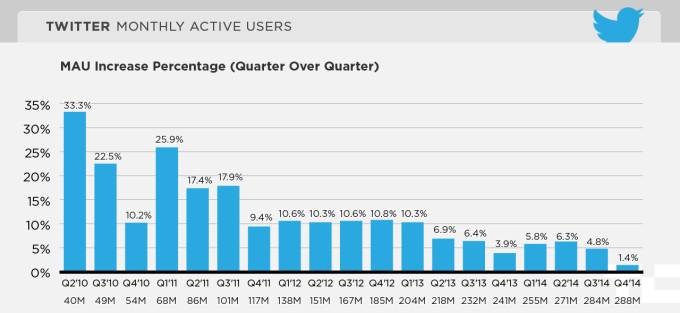
Note that Twitter has 302m monthly active users as of Q1 2015, which is a 4.86% increase from Q4 2014.
Why is Twitter Decelerating?
Yes Twitter has reduced its net loss from 2013 to 2014 and yes it is still growing, but the quarterly results and the decline in growth are concerning since they affect Twitter’s validity as an advertising platform. Comparing the year-on-year figures, although Q1 2015 revenue was up by 74.03%, the revenue of $435.94m fell short of the average analyst estimate of $456.8m – also, net profit fell by 22.73% in the same period.
Twitter does not resonate with advertisers and its current 302m members is not as appealing as Facebook’s and its subsidiaries’ membership numbers. Additionally, use of ‘newer direct response products’, i.e. hard-sell methods which create immediate sales or traffic rather than ads designed with a softer approach in mind, is attributed as being the cause of Twitter’s failure to hit targets.
In an attempt to allay concerns with the platform, Costolo has stated that ‘we have a strong pipeline that we believe will drive increased value for direct response advertisers in the future’. However, the penetration of any upcoming innovation will be constrained by the problems that lie at the heart of the platform.
Twitter’s Limitations
Twitter does not possess as much data on its users as Facebook so it is harder for Twitter to sell itself as an effective advertising platform. Twitter marketers cannot target users as specifically as they can on Facebook which offers the use of highly nuanced ‘Dark Posts’. As anecdotal evidence, the disparity in the use of data between the two platforms became evident to me when I saw an irrelevant advert for summer bikinis from Missguided on my Twitter timeline, whereas on Facebook I was hit with an advert for mobile phone mounts after I had been searching for tripod mounts a few days earlier. It is this lack of targeting which has contributed to revenues falling short of targets.
Twitter is noisy and cluttered. As of Q1 2015, there are 302m monthly active users and timelines are now filled with so much noise that the platform does not hold the user’s attention (this is why the largest media networks are publishing content on Snapchat, because the disappearing nature of the content forces users to pay attention). The lack of engagement is why people tweet using images and why there are so many click-bait articles and ‘listicles’. Despite these attempts to attract attention, with so much noise, marketers cannot truly connect with their audience and, combined with its limited application of data, the value proposition of marketers’ already-limited ‘targeted’ ads are diluted whenever the timeline is refreshed and x amount of tweets pushes the ad down.
Bullying and trolling run rampant on the platform, and both are key reasons for stagnating growth. In February 2015, Costolo stated that ‘[w]e suck at dealing with abuse and trolls on the platform and we’ve sucked at it for years… We lose core user after core user by not addressing simple trolling issues that they face every day.’ With the risk of being trolled limiting growth numbers, marketers’ opportunities to fully exploit the platform are capped at a non-maximised growth rate which reduces the value that marketers gain in exchange for utilising Twitter.
People do not like advertising but they do like content marketing. You might have seen the Kenco #CoffeeVsGangs ads in your timeline and, as cynical as it sounds, this is content marketing at its finest. This is because Kenco is indirectly advertising its brand via the publication of its corporate social responsibility. Once it gains traction and the virality of the hashtag grows, Kenco’s goodwill will increase exponentially. However, more often than not, marketers are constrained by their budgets and need to see results immediately. This is what Costolo attributes as being the reason for the recent disappointing increase in revenue.
The Future
Twitter needs to bulk up its capabilities as an effective advertising platform. However, despite purchasing 6 companies a year since 2011, which include marketing, analytics and advertising software firms, Twitter still only accounts for less than 1% of the total $145bn spent on digital advertising worldwide in 2014 – it lags behind Facebook which currently holds 7.93% of the market. Unless it drastically improves its trove of personal data available to marketers, regains users’ attention and addresses bullying on the platform, marketers will not fully invest their efforts into Twitter.
There have been attempts to regain traction, e.g. the acquisition of TellApart, an ex-Facebook ad partner that produces targeted ads, for $533m worth of shares in Twitter in April 2015. The company hopes that this will build upon the previous acquisitions to improve Twitter’s viability as an adtech platform. The company also purchased Periscope for $100m this past March to further improve engagement. Until the quarterly results and growth rates are published, it is hard to fully evaluate the effect of such acquisitions. However, as demonstrated by the company lowering its full-year expectations after the release of its Q1 results, it is near certain that Twitter will continue to plateau.
Marketers need to better engage with the platform and Twitter is attempting to facilitate this with the upcoming introduction of Project Lightning, a curated news service. Whenever a large-scale event happens, people flock to Twitter for information and this is exactly what Twitter needs to monopolise: it needs to consolidate its position as being the first service that people turn to for information, and the introduction of this new curated feed should do just that. As an extension of previous investor Chris Sacca saying that Twitter needs to be the owner of the space for trending events, such ownership will lead to marketers increasing their Twitter-expenditure as they will be able to capitalise on live advertising whilst cutting through the usual noise and clutter.
Conclusion
Without increasing engagement, the growth rates of monthly active users will continue to deteriorate which will result in further disappointing revenues. A continued decrease in growth might represent the fact that Twitter is reaching its maximum scalability and such deceleration would impose a limit on the revenue that can be generated from its position as an adtech platform with a finite number of users.
Therefore, with the company’s current dwindling figures and growing shareholder discontent, Twitter needs to innovate as soon as possible otherwise it risks coming to the end of its run and being remembered as an example of fad-tech.
For more information, please do not hesitate to contact me.

 The Byte Direction