Tag Archives: Investment

Starting Up a Start Up – “Show Me the Money”

Starting up a Start Up – “Show Me the Money”

Start ups are a big deal. Their ability to disrupt traditional modes of business have attracted sky-high valuations and the recent news is that Airbnb is in the process of a $900m-1bn funding round which values the private company at $24bn, and Uber is currently in a $1.5-2bn round which values the ride-sharing service at an eye-watering $50bn. To put these figures into context, Airbnb now has a higher valuation than international hotel chain Mariott International ($20.46bn) and Uber’s new valuation takes the company higher than 406 public companies on the S&P 500.

But before a start up can become a unicorn (a company with a valuation of at least $1bn) and reach such dizzying valuations through ‘Private IPOs’, a start up needs to first start up. There are two main financing options for a fledgling company: debt finance by way of a bank loan and equity finance via venture capital (‘VC’) investment. There is also a hybrid method of financing known as convertible debt. Which of these is more suitable?

Option 1: Bank Loan/Debt Finance

A bank loan is the provision of money from a bank in exchange for regular repayments plus interest. There is no dilution of equity so existing shareholders’ control of the company will not be affected, but the youthfulness of the company will prove problematic.

The lack of a financial history means that the bank will impose onerous obligations on the company to ensure repayment. The company is likely to be a high credit risk so the loan will be secured on the start up’s assets, such as any physical property, intellectual property rights, contracts etc. This security will grant the bank priority in the event of the borrower’s insolvency by allowing it to enforce its security over these assets so as to settle the outstanding debt. This security causes administrative problems because any dealing/disposal of these assets would require the bank’s consent. A start up requires agility and freedom, but a bank’s security would introduce a layer of bureaucracy within the company that would previously have had a fluid operational system.

Note also that, since the company is so young and is not seen as having a stable foundation, banks often require the start up’s founders (often also the directors) to guarantee the debt. They will therefore become personally liable if the company defaults. This is obviously very risky for the individuals guaranteeing the loan due to the substantial personal liabilities that can be incurred, so personal guarantees must be taken into account when considering debt finance.

As another result of the company’s credit risk, the bank will require repayments to be made on a regular basis plus interest. This is vital to the bank because it wants to ensure the safety of its investment and maintain a regular income stream. Consequently, regardless of its profits, the start up will have to stick to its repayment schedule otherwise it risks the bank calling an event of default and accelerating its loan (requiring immediate repayment) and enforcement of the security. Bearing in mind that failure to repay already indicates the start up’s financial ill health, any steps taken by the bank in such a situation would likely break the company. It is also important to note that the threat of defaulting is likely to change the culture of the start up since early development companies are generally more concerned with their products and traction, rather than pure financial figures.

Because of these onerous impositions, a standard loan is unlikely to be suitable for a start up.

Venture Debt

This is a specialised loan aimed specifically at start up companies that have assets, an existing customer base and/or financial history. Especially popular with niche banks in Silicon Valley and growing in use, this method of finance combines the advantages of a loan and VC in that there is no dilution to shareholdings and the company will obtain expertise and connections. However, venture debt would still require the debt to be fixed to the company’s assets, possibly require personal guarantees and will require the company to make regular repayments plus interest.

Option 2: Venture Capital/Equity Finance

First utilised in what was not yet known as Silicon Valley in the late 1950s/early 1960s, VC is characterised by the provision of money in exchange for a percentage of the company’s shares on a preferred basis, rather than common stock, so as to protect the investor during insolvency.

The very first issue to overcome in relation to VC is the fact that shares will be issued. This will require the company to follow company procedure, as set out in the start up’s articles of association/constitution, and is a more complex process than obtaining a bank loan. Once shares are issued, existing shareholdings will be diluted and the Investment Agreement (the ‘Agreement’) would import controls necessary to protect the VC investment. For example, the investor would gain consent rights so that the company must seek approval for any significant decisions, and the Agreement would also grant rights to board representation and impose restrictive covenants on the company so as to reduce the risk. In addition to a restriction on the dilution of the VC firm’s shares, the Agreement would also typically include ratchet provisions that scale up the investor’s acquired equity in the event that targets are not achieved. Entrepreneurs must therefore carefully compare the terms of the Agreement against the capital being receive and make a decision on whether or not the terms are proportionate to the level of funding.

Despite these drawbacks, VC investment would present the company with a much better prospect of growth than a bank loan. The main benefit is that the start up will obtain the expertise and industry connections required to expand the company. This is why Don Valentine in the documentary ‘Something Ventured’ states that his approach to investments was “[i]s our Rolodex strong enough to help these people?” The support that a start up will receive is not offered by a bank and is a key factor that will drive the growth of the company.

Also in contrast to a bank loan is the fact that there are no repayment obligations. Although VC investors will join as shareholders and receive dividends, a regular income stream is not the priority. Instead, the aim of VC is to create a capital gain upon an exit from the company. This therefore minimizes the short term pressure that the start up will face and gives the business time to maximise success.

The Double Edged Sword of Venture Capital

Since VC is provided in exchange for shares, the risk is shared which alleviates some pressure from the pre-existing shareholders’ shoulders. The investor will therefore also have an interest in the company’s success and strive to make it as profitable as possible. However,  at Internet Week 2015, Gary Vaynerchuk perfectly summarised the double edged sword of VC:

“A VC’s playing a game of just one “unicorn” and it pays the whole game… VCs are pushing all these young entrepreneurs in the right direction because if one breaks who gives a **** if you failed on the other hundred, your [return on investment] is so intense on that one Uber, on that one Facebook, that it makes the math work… They’re managing a portfolio and so they’re giving the advice that’s best in their interest…”

The problem is therefore that, although the overall aim for both the start up and the investor is to build growth, the way in which the mission is completed can create tension between the parties. It is because of this that entrepreneurs must ‘separate advice that’s in someone else’s best interest and take the advice that’s in their best interest’, and carefully vet potential VC investors.

Another issue that needs to be considered when evaluating VC investment is the current culture of companies celebrating giving away equity in order to achieve a ‘milestone’. The start up needs to carefully evaluate whether external investment is truly needed or whether it can make a go of the venture on its own. For example, Vaynerchuk is attracted to ‘building from zero’ instead of unnecessary VC investment because it teaches you core principles of business. He states that the ‘lack of patience… will be the death to 95% of the businesses that are in play right now. Lack of patience is the vulnerability in the marketplace right now.’ These ideas, along with the notions of ‘learning to fail’ and ‘learning through failure’, perhaps sound romantic, but they do need to be taken into account when deciding whether or not to issue equity.

Option 3: Convertible Debt/Hybrid Financing 

This form of financing is a hybrid of options 1 and 2 because it starts out as a loan but converts into equity capital after a certain period of time or upon the occurrence/non-occurrence of a particular event. Obtaining convertible debt is a much cheaper and quicker process than issuing shares, but companies need to be aware that an investor will often set the term of the loan so that it expires after the next round of financing. In such a case, if the loan expires prior to further funding, the investor will require the money to be repaid or the loan will convert into equity – the former has the potential to require the business to be sold at a distressed price so as to settle the debt, and the latter will dilute shareholdings.

Conclusion

Whichever method of financing is chosen, the company needs to evaluate the impact of external investment on the business. External financing must be in the business’ best interests and it must not be obtained purely for the purposes of any internal gratification of reaching a milestone. Additionally, while VC is the most popular route, entrepreneurs need to be wary that it is a double edged sword and not get caught in the excitement of VC investment.
Twitter – AdTech or Fad-Tech?

Twitter – AdTech or Fad-Tech?

With the recent news of Twitter’s disappointing Q1 2015 results and CEO Dick Costolo announcing his resignation, is Twitter an effective platform within adtech (the use of technology in relation to advertising) or is it just fad-tech that is nearing the end of its run?

Resignation

Costolo will be resigning from the position on 1 July 2015 and will be replaced on an interim basis by Twitter co-founder Jack Dorsey. Costolo has been on the board since 2010 and led the company through its Initial Public Offering (IPO) in November 2013 when it had a market cap of $24.5bn. Since then, Twitter’s valuation has decreased by 41% from a high of $40bn in December 2013 to its current market cap of $23.48bn. It is this stagnation that has led to Costolo’s resignation.

The Financial Numbers

From 2013 to 2014, Twitter has increased its annual revenue by 111% which has corresponded to a 10.46% increase in its net profit. However, this positive change still resulted in a net loss of $577m. Note that the results for the year ending December 31 2013 should not be overstated as 2013 was the year in which Twitter went public.

All values in $000,000’s
Dec 31 2014 Dec 31 2013 (Year of IPO) Dec 31 2012
Total Revenue 1,403.00 664.89 316.93
Annual Revenue Growth (%) 111.01 109.79
Net profit -577.82 -645.32 -79.40
Annual Net Profit Comparison (%) 10.46 increase 712.75 decrease

In relation to the previous 5 quarters, Twitter has experienced:

  • A decrease in revenue of 9.00% from Q4 2014 to Q1 2015;
  • An increase in revenue of 74.03% from Q1 2014 to Q1 2015;
  • A net profit decrease of 29.59% from Q4 2014 to Q1 2015; and
  • A net profit decrease of 22.73% from Q1 2014 to Q1 2015. 
All values in $000,000’s
  Q1 2015 Q4 2014 Q3 2014 Q2 2014 Q1 2014
Total Revenue 435.94 479.08 361.27 312.17 250.49
Net Profit -162.44 -125.35 -175.46 -144.64 -132.36

 Total Monthly Active Users

In addition to increasing competition from Snapchat, Twitter has been eclipsed by the number of monthly active users on Instagram (300m as of December 2014) and WhatsApp (800m as of April 2015) which are both owned by Facebook (1.4bn as of Q1 2015).

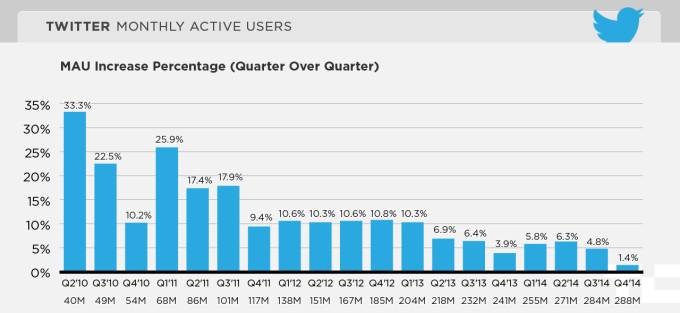
The following demonstrates Twitter’s decelerating growth in its number of total monthly active users:

Growth Rates
Period Total Monthly Active Users (000,000’s) Q4 Year on Year Comparison (%) Average Annual Growth (%)
2010 – 2011 54 – 117 116.67 17.65
2011 – 2012 117 – 185 58.12 10.56
2012 – 2013 185 – 241 30.27 6.88
2013 – 2014 241 – 288 19.50 4.58

Note that Twitter has 302m monthly active users as of Q1 2015, which is a 4.86% increase from Q4 2014.

Why is Twitter Decelerating?

Yes Twitter has reduced its net loss from 2013 to 2014 and yes it is still growing, but the quarterly results and the decline in growth are concerning since they affect Twitter’s validity as an advertising platform. Comparing the year-on-year figures, although Q1 2015 revenue was up by 74.03%, the revenue of $435.94m fell short of the average analyst estimate of $456.8m – also, net profit fell by 22.73% in the same period.

Twitter does not resonate with advertisers and its current 302m members is not as appealing as Facebook’s and its subsidiaries’ membership numbers. Additionally, use of ‘newer direct response products’, i.e. hard-sell methods which create immediate sales or traffic rather than ads designed with a softer approach in mind, is attributed as being the cause of Twitter’s failure to hit targets.

In an attempt to allay concerns with the platform, Costolo has stated that ‘we have a strong pipeline that we believe will drive increased value for direct response advertisers in the future’. However, the penetration of any upcoming innovation will be constrained by the problems that lie at the heart of the platform.

Twitter’s Limitations

Twitter does not possess as much data on its users as Facebook so it is harder for Twitter to sell itself as an effective advertising platform. Twitter marketers cannot target users as specifically as they can on Facebook which offers the use of highly nuanced ‘Dark Posts’. As anecdotal evidence, the disparity in the use of data between the two platforms became evident to me when I saw an irrelevant advert for summer bikinis from Missguided on my Twitter timeline, whereas on Facebook I was hit with an advert for mobile phone mounts after I had been searching for tripod mounts a few days earlier. It is this lack of targeting which has contributed to revenues falling short of targets.

Twitter is noisy and cluttered. As of Q1 2015, there are 302m monthly active users and timelines are now filled with so much noise that the platform does not hold the user’s attention (this is why the largest media networks are publishing content on Snapchat, because the disappearing nature of the content forces users to pay attention). The lack of engagement is why people tweet using images and why there are so many click-bait articles and ‘listicles’. Despite these attempts to attract attention, with so much noise, marketers cannot truly connect with their audience and, combined with its limited application of data, the value proposition of marketers’ already-limited ‘targeted’ ads are diluted whenever the timeline is refreshed and x amount of tweets pushes the ad down.

Bullying and trolling run rampant on the platform, and both are key reasons for stagnating growth. In February 2015, Costolo stated that ‘[w]e suck at dealing with abuse and trolls on the platform and we’ve sucked at it for years… We lose core user after core user by not addressing simple trolling issues that they face every day.’ With the risk of being trolled limiting growth numbers, marketers’ opportunities to fully exploit the platform are capped at a non-maximised growth rate which reduces the value that marketers gain in exchange for utilising Twitter.

People do not like advertising but they do like content marketing. You might have seen the Kenco #CoffeeVsGangs ads in your timeline and, as cynical as it sounds, this is content marketing at its finest. This is because Kenco is indirectly advertising its brand via the publication of its corporate social responsibility. Once it gains traction and the virality of the hashtag grows, Kenco’s goodwill will increase exponentially. However, more often than not, marketers are constrained by their budgets and need to see results immediately. This is what Costolo attributes as being the reason for the recent disappointing increase in revenue.

The Future

Twitter needs to bulk up its capabilities as an effective advertising platform. However, despite purchasing 6 companies a year since 2011, which include marketing, analytics and advertising software firms, Twitter still only accounts for less than 1% of the total $145bn spent on digital advertising worldwide in 2014 – it lags behind Facebook which currently holds 7.93% of the market. Unless it drastically improves its trove of personal data available to marketers, regains users’ attention and addresses bullying on the platform, marketers will not fully invest their efforts into Twitter.

There have been attempts to regain traction, e.g. the acquisition of TellApart, an ex-Facebook ad partner that produces targeted ads, for $533m worth of shares in Twitter in April 2015. The company hopes that this will build upon the previous acquisitions to improve Twitter’s viability as an adtech platform. The company also purchased Periscope for $100m this past March to further improve engagement. Until the quarterly results and growth rates are published, it is hard to fully evaluate the effect of such acquisitions. However, as demonstrated by the company lowering its full-year expectations after the release of its Q1 results, it is near certain that Twitter will continue to plateau.

Marketers need to better engage with the platform and Twitter is attempting to facilitate this with the upcoming introduction of Project Lightning, a curated news service. Whenever a large-scale event happens, people flock to Twitter for information and this is exactly what Twitter needs to monopolise: it needs to consolidate its position as being the first service that people turn to for information, and the introduction of this new curated feed should do just that. As an extension of previous investor Chris Sacca saying that Twitter needs to be the owner of the space for trending events, such ownership will lead to marketers increasing their Twitter-expenditure as they will be able to capitalise on live advertising whilst cutting through the usual noise and clutter.

Conclusion

Without increasing engagement, the growth rates of monthly active users will continue to deteriorate which will result in further disappointing revenues. A continued decrease in growth might represent the fact that Twitter is reaching its maximum scalability and such deceleration would impose a limit on the revenue that can be generated from its position as an adtech platform with a finite number of users.

Therefore, with the company’s current dwindling figures and growing shareholder discontent, Twitter needs to innovate as soon as possible otherwise it risks coming to the end of its run and being remembered as an example of fad-tech.

For more information, please do not hesitate to contact me.

The Power of Tesla

“The issue with existing batteries is that they suck” – Elon Musk, CEO of Tesla

In keeping with its name and goal of energy innovation, Tesla recently revealed its new stackable battery system that stores electricity for both domestic and commercial use. Although no specific figures have been released, the new batteries are expected to increase Tesla’s annual revenue by billions.

Domestic units known as the Powerwall are currently available for pre-order for shipping in the summer. Prices start from $3,500 and units will provide enough electricity to run some home appliances for a few days in a blackout. The consensus is that this price point appeals to those whose homes are solar powered, but it is not yet cheap enough for either the average US or the average UK national grid-connected customer.

The larger version, the Powerpack, has been gaining traction and Tesla counts Wal-Mart, Amazon and Target as its customers. An undisclosed utility company has also approached Tesla for an order of 2,500 Powerpack towers. In the short term, this seems to be more promising than the batteries for residential use and commercial success could lead to penetration into the energy industries of emerging markets that rely heavily on diesel such as India – the potential here is therefore extremely high.

Tesla’s Relationship with its Investors

Tesla is not without its sceptics and its own investors wonder when the company will begin to make money. In the past three years, Tesla has made losses of $294m, $74m and $396m from revenues of $3.2bn, $2bn and $413m in 2014, 2013 and 2012 respectively. In the face of increasing shareholder pressure, there are three areas that could perhaps be streamlined: “Cost of Revenue”, “Cost of Research and Development”, and “Cost of Sales, General and Admin.”. These are the exact figures:

All values in $000’s
2013/2014 2012/2013 2011/2012
Total Revenue 3,198,356 2,013,496 413,256
Cost of Revenue 2,316,685 1,557,234 383,189
Cost of Research and Development 464,700 231,976 273,978
Cost of Sales, General and Admin. 603,660 285,569 150,372

Given that Tesla is so high profile and tech-dependent, it is not surprising to see such high costs. However, these figures significantly lower its total revenue and could be reduced to ease investor discontent.

It was expected that Chinese sales of Tesla’s Model S electric car would be roughly on par with US sales, but Tesla has so far found China to be a difficult market With two China managers having already left the company in 2014, a positive international outlook is something that investors will gauge Tesla’s success by. In recognition of this, and under need to better tap into China, Musk has not been shy of informing the company that country managers who are ‘not on a clear path to positive long-term cash flow’ will be removed.

A Long Term Bet

After failing to meet its target for the number of car deliveries in 2014 and inconsistent earnings per share, what does the future hold for Tesla?

Judging from the falling prices of batteries and the increase in the economic viability of solar power, the energy storage industry will soon be breaking open and Tesla’s position within the domestic battery market will pivot on how much economic appeal it can find with consumers. However, its already-strong base in the commercial market, increased projections for car deliveries (50,000 for 2015 growing to 500,000 by 2020) and the expected release of its new SUV (the Model X) suggest a more investor-friendly company with significantly higher revenue. Whether revenue will result in profit remains to be seen, but Tesla is a high profile, research-dependent company so a corresponding increase in the three aforementioned costs is also to be expected.

Tesla has previously been linked to an acquisition by Google and there are current rumours of an acquisition by Apple. These rumours show that, despite the fact that Tesla is not currently making money, its potential is extremely concerning/attractive to two of the most pioneering technology companies. Regardless of how other companies view the company, this can only provide Tesla with a positive long term outlook. Investors who are still bullish on the company are therefore likely to be betting on the company either to continue to grow and eventually make a profit, or to become a vehicle for a successful exit upon an acquisition, and each of these scenarios is likely to compensate investors for their current dissatisfaction.

For more information, please do not hesitate to contact me.